Dental Implants or Dentures: Understanding Your Options
2 September 2026 | Dental Fees & Financing, Dental Technology, General Dentistry
If you have searched for dental implants and dentures near me, you are probably trying to work out which tooth replacement option fits your mouth, budget, health and day-to-day life. The short answer is that both dental implants and dentures can be considered for missing teeth, but they work in different ways. Neither is automatically the right choice for every patient, and a dental examination is needed before a dentist can recommend an option.
Searching for dental implants and dentures near me in Geelong?
For people in Geelong, Newtown, Geelong West, East Geelong, Belmont, Highton and nearby areas, the decision often starts with a practical question: should I replace missing teeth with something removable, something fixed or a combination of both?
Missing teeth can affect chewing, speech, the way teeth meet together and the appearance of the smile. Some people also notice that remaining teeth shift into spaces over time. Replacing teeth may help with function and comfort, but the most suitable approach depends on your oral health, medical history, bone levels, gum health, treatment goals and what you feel comfortable maintaining.
This guide explains the main differences between dental implants and dentures, what an appointment may involve and which questions are worth asking before making a decision.
What are dental implants?
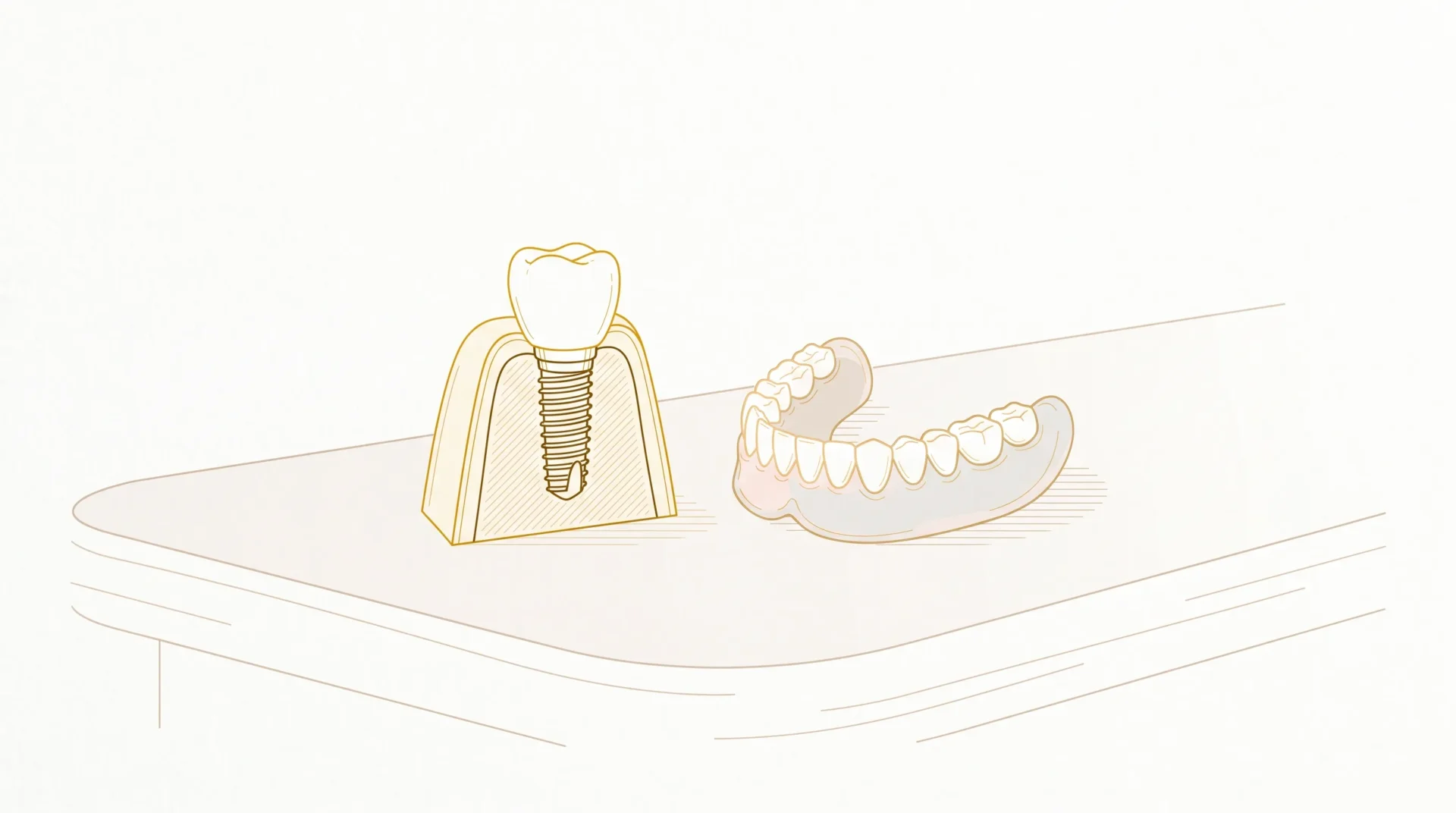
A dental implant is a small artificial tooth root, often made from titanium, that is placed into the jawbone during a surgical procedure. Once the area has healed and the implant has integrated with the bone, a dentist may attach a crown, bridge or denture to it.
Dental implants can sometimes be used to replace one missing tooth, several missing teeth or a full arch of teeth. The Australian Dental Association’s patient information about dental implants explains that implants are designed to support replacement teeth, but careful assessment is needed before treatment.
Possible benefits of dental implants may include:
- Support for a crown, bridge or denture that does not rely only on the gums
- A stable option for some patients who are suitable for implant treatment
- No need to remove a single implant crown for daily cleaning, although cleaning around it is still essential
- The ability to support full-arch options in selected cases
Implants also have limitations. They involve surgery, healing time and ongoing maintenance. Some patients need additional procedures such as bone grafting before implant placement can be considered. Implant treatment may not be suitable for everyone, particularly where there are certain medical conditions, insufficient bone, active gum disease or factors that may affect healing.
What are dentures?
Dentures are removable appliances that replace missing teeth and some of the surrounding gum shape. A partial denture replaces some teeth, while a full denture replaces all teeth in the upper jaw, lower jaw or both. Dentures can be made from different materials, and the design depends on the number and position of missing teeth.
Healthdirect provides general patient information about dentures, including how they are used and why follow-up care matters.
Conventional dentures usually do not require implant surgery, although some patients may need extractions, gum treatment or other dental care before a denture can be made. Dentures are often considered when several teeth are missing, when surgery is not preferred or suitable, or when a removable option is the preferred pathway.
Possible benefits of dentures may include:
- Replacement of multiple missing teeth with a removable appliance
- No implant surgery for conventional full or partial dentures
- A possible option when bone levels or medical factors make implants less suitable
- Adjustability or replacement over time as the mouth changes
Dentures also have limits. Some people need time to adapt to eating and speaking with them. Dentures can rub, feel loose or need relining as gums and bone change. They also need daily cleaning and should be reviewed if they become uncomfortable.
Dental implants vs dentures: a practical comparison
The right option is not decided by a table alone, but comparing the main features can make the conversation with your dentist easier.
| Feature | Dental implants | Dentures |
|---|---|---|
| How they are supported | Placed in the jawbone and used to support a crown, bridge or denture | Rest on the gums and may use clasps on remaining teeth for support |
| Removable or fixed | Single implant crowns and implant bridges are usually fixed, while some implant-supported dentures are removable | Usually removable |
| Surgery involved | Yes, implant placement is a surgical procedure | Conventional dentures do not involve implant surgery, but other dental treatment may be needed first |
| Treatment time | Often staged over several appointments with healing time | Usually planned, made and adjusted over several appointments |
| Maintenance | Daily cleaning around the implant, regular dental reviews and care of attached components | Daily cleaning of the denture and mouth, regular fit checks and possible adjustments |
| Suitability | Depends on bone, gum health, medical history, bite and other factors | Depends on remaining teeth, gum shape, bite, comfort and ability to manage a removable appliance |
What does an assessment usually involve?
Before discussing implants, dentures or other tooth replacement options, your dentist needs to understand what is happening in your mouth. This is also a good time to raise any concerns about previous dental experiences, gag reflex, anxiety, disability support needs or difficulty attending multiple appointments.
An assessment may include a discussion of your dental goals, a medical history review, examination of your teeth and gums, bite assessment and dental X-rays or scans if clinically appropriate. Your dentist may also check whether any decay, gum disease or infection needs to be managed before replacement teeth are planned.
If you are unsure what an initial visit might look like, Geelong Dental Centre’s guide to what to expect when visiting a Geelong dentist explains the usual booking, examination and treatment planning process in more detail.
Some patients benefit from bringing a support person to help remember information, ask questions or discuss practical needs. Families and carers may also plan dental appointments around work, school, study, sport or structured supports. For example, community day activity programs such as Ons Plekske show how routine, familiar activities and support structures can be important for young people with disability or autism, and similar planning principles can help make healthcare appointments easier to manage.
Factors that may influence which option suits you
Your dentist will not usually recommend a tooth replacement option based only on the number of missing teeth. Several factors can affect suitability.
Oral health is one of the first considerations. Active gum disease, untreated decay or infection may need attention before implants or dentures are planned. Gum and bone health also matter because implants need adequate support, while dentures need a stable foundation to sit on.
General health can also play a role. Conditions or medicines that affect healing, bone health or bleeding risk may influence the timing or type of treatment. Smoking can affect oral health and healing, so your dentist may discuss this when planning surgical or restorative care.
Lifestyle and preferences matter too. Some people prefer a removable option because they want to avoid surgery or keep treatment simpler. Others may be interested in implant-supported options because they want added stability and are suitable after assessment. Cost, treatment time, maintenance and the number of appointments should all be discussed clearly before treatment begins.
Dental implants, dentures or a combination?
It is not always a choice between only dental implants or only dentures. Some patients may be suitable for an implant-supported denture, where a removable denture attaches to implants for additional support. Others may be better suited to a conventional denture, a dental bridge or no immediate replacement if monitoring is appropriate.
Full-arch implant treatment may be discussed when most or all teeth in an arch are missing or cannot be kept. All-on-4 is one type of full-arch implant approach, but it is not suitable for every patient. Suitability depends on bone shape and volume, bite forces, oral hygiene, medical history and the condition of any remaining teeth.
A dentist should explain the potential benefits, risks, limitations and alternatives for each option. Treatment outcomes and experiences vary between patients, and no implant or denture can be described as permanent or risk-free.
Costs and timeframes in Geelong
The cost of replacing missing teeth varies because treatment plans vary. A single implant crown, partial denture, full denture, implant-supported denture and full-arch implant treatment all involve different stages, materials and clinical requirements.
Costs may be influenced by:
- The number of teeth being replaced
- Whether extractions, gum treatment or bone grafting are needed
- The type of denture or implant restoration planned
- The number of appointments and laboratory stages involved
- The need for scans, surgical planning or follow-up reviews
- Your private health insurance cover, if you have it
Before committing to treatment, ask for an itemised estimate and a clear explanation of what is included. Geelong Dental Centre offers flexible payment options, and the team can discuss these with you if treatment is recommended after assessment.
If you are comparing clinics or seeking another opinion, it can help to look at communication, informed consent, treatment options and whether the clinic provides the type of care you need. This guide on how to choose a dental clinic in Geelong may be useful when weighing up your options.
Risks, maintenance and follow-up care
All dental procedures carry potential risks and benefits. Implant-related risks can include infection, bleeding, swelling, discomfort, implant failure, damage to nearby structures or sinus-related complications in some upper jaw cases. The exact risks depend on the site, anatomy and treatment plan.
Denture-related issues can include rubbing, sore spots, changes to speech or chewing, looseness, breakage and the need for adjustments or relines over time. If dentures are worn over unhealthy gums or remaining teeth, they may become uncomfortable or contribute to further dental problems.
Maintenance is not optional. Implants need careful cleaning around the gumline and regular dental reviews to monitor the implant, surrounding gum and attached crown or denture. Dentures should be cleaned daily, removed as advised by your dentist and checked if they no longer fit comfortably.
A review appointment is worthwhile if you notice pain, swelling, bleeding, looseness, a cracked denture, trouble chewing or a change in the way your teeth meet. If you are unsure whether symptoms need attention, Geelong Dental Centre’s article on when you should book a dental appointment outlines common reasons to arrange dental care.
Questions to ask your dentist
A good treatment discussion should leave you with a clear understanding of your choices. You may want to ask:
- What options are suitable for my mouth, and why?
- Do I need any treatment before replacing the missing tooth or teeth?
- What are the benefits, risks and limitations of each option?
- How many appointments may be involved?
- What daily care will I need to manage at home?
- What costs, payment options and health fund item numbers apply?
- What happens if the denture, implant crown or attachment needs repair in the future?
It is reasonable to take time to think about your options, especially for complex or higher cost treatment. Written information can help you compare choices at home without pressure.
Frequently Asked Questions
Are dental implants better than dentures? Not necessarily. Dental implants and dentures work differently, and the better option depends on your oral health, medical history, bone levels, budget, preferences and ability to maintain the treatment. A dentist can assess whether either option may be suitable.
Can I have dentures first and implants later? Some patients may start with dentures and consider implants later, but this depends on bone levels, gum health and the overall treatment plan. If this is something you are considering, mention it early so your dentist can factor it into planning.
Do dentures need to be replaced? Dentures may need adjustment, relining, repair or replacement over time because the mouth changes. If a denture becomes loose, uncomfortable or difficult to chew with, arrange a dental review rather than trying to adjust it yourself.
How long does implant treatment take? Implant treatment is often staged, with time allowed for healing and for the implant to integrate with the bone. The timeframe varies between patients and may be longer if extractions, grafting or other treatment is needed.
What if I am missing all teeth in one jaw? Options may include a full denture, implant-supported denture or full-arch implant treatment in selected cases. Your dentist can explain which options may be appropriate after assessing your mouth, jawbone, bite and medical history.
Discussing your options in Geelong
If you are comparing dental implants and dentures, a dental examination can help clarify what is suitable for your mouth and what alternatives are available. The discussion should include possible benefits, risks, costs, maintenance and realistic expectations.
To discuss missing teeth or replacement options in Geelong, you can book an appointment with Geelong Dental Centre. Your dentist can assess your oral health and explain which options may be appropriate for your circumstances.
Disclaimer
The information provided on this website is for general informational and educational purposes only. It is not intended to replace professional dental advice, diagnosis or treatment. Dental needs and treatment outcomes vary between individuals. Always seek advice from a qualified dental practitioner regarding your specific circumstances before making decisions about your oral health or treatment. A consultation and clinical assessment are required to determine which treatment options may be suitable for you. All dental procedures carry potential risks and benefits, which will be discussed with you before treatment.